
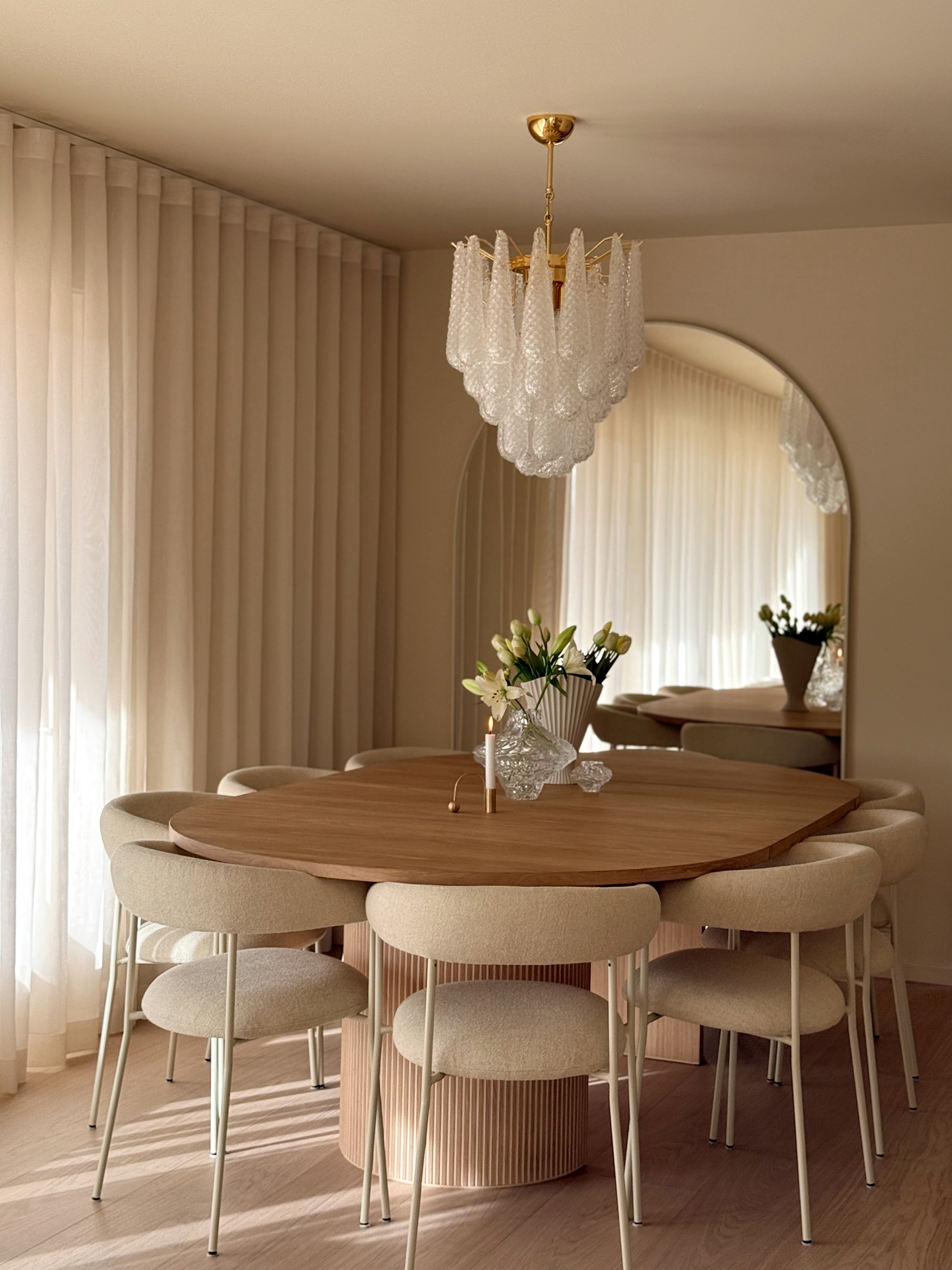

Origin
Where our chandeliers are made
People often ask whether our chandeliers are made on Murano. They are not, and we say so plainly. Here is where and how they are made, and what to ask any seller.

At a glance
- Made in
- Italy, on the mainland near Venice
- Technique
- Hand-blown glass, assembled by hand
- The glassmakers
- Over 20 years of experience
- Production
- Made to order, usually 2–3 weeks
- Certificate
- Our own signed Handcrafted in Italy certificate on request
- Shipping
- Fully insured door to door, with one or two spare glasses in the box
The island of Murano and the mainland: what is the difference?
Murano has been the centre of Venetian glassmaking since 1291, when Venice moved its glass furnaces out to the island. Today many of the region's glassmakers work on the mainland. The technique is the same. What differs is the place, and the mark that comes with it.
| Glass made on the island of Murano | Our chandeliers | |
|---|---|---|
| Place | The island of Murano in the Venetian lagoon | The mainland near Venice, about an hour from Murano |
| Technique | Hand-blown and shaped by hand | Hand-blown and shaped by hand, using the same techniques |
| Vetro Artistico® Murano | Available to approved workshops on the island | No. The mark only covers glass made on the island. |
| Documentation | The mark's label or certificate | Our own signed Handcrafted in Italy certificate on request |
| The word "Murano" | Says where the glass was made | Says which style and tradition the chandelier follows, not where it was made |
Vetro Artistico® Murano is a collective trademark under Veneto Regional Law no. 70/1994. It protects glass produced on the island of Murano, and only approved producers may use it.

How a chandelier is made
-
The glass is melted
Sand and minerals are melted in the furnace. Colour comes from metal oxides in the molten glass itself, so it runs through the whole piece.
-
Each glass is blown by hand
The glassmaker gathers glass on the blowpipe and shapes each element by hand, whether it is a tube, a drop, a poliedro or a leaf. That is why no two are exactly alike.
-
The surface gets its texture
On some glasses, graniglia, fine grains of glass, is applied to the surface while the glass is still hot. It gives the textured sparkle you see on the drop glasses, among others.
-
The glass cools slowly
Finished glasses are cooled over time in a separate oven, so they do not develop stress or cracks.
-
Frame and assembly
The frame is made in the finish you choose, and the chandelier is assembled by hand.
-
Packed and shipped
The chandelier is packed with one or two spare glasses and shipped fully insured, door to door. From order to delivery usually takes 2–3 weeks.
How to recognise hand-blown glass
Hand-blown glass carries small traces of the hands that made it. Look for these:
- Tiny air bubbles. Small bubbles in the glass are normal and a sign of handwork, not a flaw.
- Slight variations. Thickness, length and shape vary a little from glass to glass.
- Colour in the glass. The colour sits in the glass itself, not as paint on the surface.
Pressed and moulded glass, by contrast, is identical from piece to piece.

Five questions to ask any seller
Wherever you buy, these questions give you a clear picture. Here are our answers.
| Question | Why it matters | Our answer |
|---|---|---|
| Where exactly is the glass made? | "Murano" often describes the style, not the place. | In Italy, on the mainland near Venice. |
| Is the glass hand-blown? | Pressed and moulded glass is cheaper to make and identical from piece to piece. | Yes, every single glass. |
| If the seller says "genuine Murano", what proves it? | Vetro Artistico® Murano is the scheme for glass from the island. | We do not say "genuine Murano". You can have a signed Handcrafted in Italy certificate. |
| Do spare glasses come with it? | Glass can break in transit or during installation. | Yes, one or two spares in every shipment. Spare parts can always be ordered. |
| Is shipping insured? | A chandelier travels a long way. | Yes, door to door. If anything breaks, we replace it free of charge within 14 days of delivery. |
Questions and answers
About origin
No. They are hand-blown in Italy, in the Murano tradition, by glassmakers on the mainland near Venice, about an hour from the island.
"Murano" is the name of the style and the glassmaking tradition the chandeliers follow. We use the word for the design and the technique, not as a claim about where the glass was made.
The chandeliers do not carry the Vetro Artistico® Murano mark, because it only covers glass made on the island. We are happy to issue our own signed Handcrafted in Italy certificate. Just ask when you order.
No. All the glass is blown in Italy, and the chandeliers are assembled and shipped from there.
No. Tiny air bubbles and variations are normal in hand-blown glass and a sign that it was made by hand.
We are happy to send you extra photos of the model and finish you are considering. Just tell us which piece.
Ask us
More questions about origin?
Write to us and we will give you a straight answer.